Army tests autonomous robots that hunt enemy targets
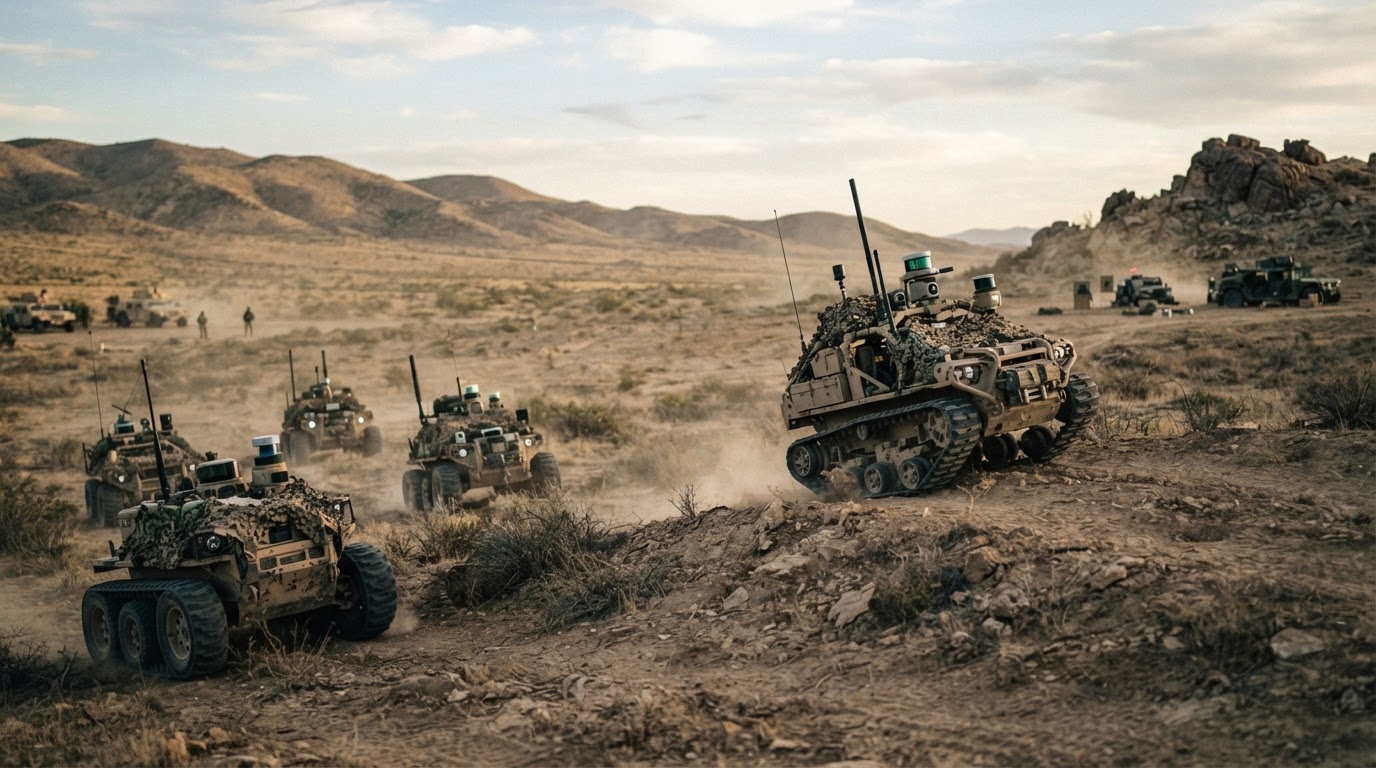
The Army tested four experimental vehicles developed under the Defense Advanced Research Projects Agency's RACER program during an Oct. 15 exercise.
Rights: fair use excerpt
No AI assistance disclosed
Executive Summary
Ground forces within the American military recently evaluated a quartet of robotic prototypes designed to autonomously seek hostile targets, according to reporting from Task & Purpose. The operational demonstration, carried out during tactical field drills in mid-October, placed four developmental platforms into field conditions to observe how machine-driven navigation and automated tracking perform under realistic parameters. The experimental hardware emerged from efforts spearheaded by the Pentagon's primary technological development agency under its resilient off-road autonomy initiative, known as the RACER venture.
As outlined by the outlet, this operational trial highlights an effort to transition mechanized autonomy from controlled laboratory proving grounds into unpredictable combat environments. The broader project managed by defense researchers seeks to overcome persistent engineering hurdles in off-road mobility, environmental perception, and algorithmic pathfinding. Rather than depending on uninterrupted manual teleoperation by human crews, machinery designed under the initiative is tasked with processing unstructured landscapes, selecting traverse routes, and recognizing adversarial positions at speeds comparable to standard combat vehicles.
The deployment of these four test units reflects the broader military movement toward integrating uncrewed ground assets into frontline tactical formations. Defense strategists are examining how autonomous target acquisition and robust computational driving can shield troops from direct hazard during reconnaissance and point-security tasks. Evaluations like the mid-October exercise provide foundational data on whether complex artificial intelligence architectures can function reliably in contested terrain without steady communication links or satellite guidance.
For commercial partners, industrial contractors, and dual-use innovators, the evaluation of experimental platforms emphasizes an accelerating appetite across the defense apparatus for ruggedized robotics and high-endurance edge computing. Crafting autonomous mobility stacks that operate without structured roads demands sophisticated breakthroughs across sensing modalities, low-power processing, and real-time computer vision. As defense branches continue evaluating such prototypes, real-world trials establish the operational requirements that commercial suppliers must fulfill when designing military-grade hardware.
For veterans, defense executives, and enterprise founders tracking national security, the ongoing assessment of uncrewed hunting apparatuses signals an evolving paradigm in combined-arms warfare. Shifting research assets from initial design phases into structured service demonstrations shows that algorithmic platforms are moving closer to tactical reality. Tracking these developmental benchmarks offers vital insight for corporate decision-makers working in the defense ecosystem, veterans following the modernization of combat arms, and civic leaders monitoring the strategic implications of autonomous warfare.
This Executive Summary is an original synthesis by Valor & Ventures Media editors based on public reporting by Task & Purpose. For the complete original article, please visit the source.
The Army tested four experimental vehicles developed under the Defense Advanced Research Projects Agency's RACER program during an Oct. 15 exercise.
— Task & Purpose
Read the full report: https://taskandpurpose.com/news/army-scifi-warfare-fort-knox/
Reporting and photography credited as noted above. Originally published by Task & Purpose. The hero image on this page is an AI-generated illustration created by Valor & Ventures Media — not a photograph from the source publication.
Checking your membership…